
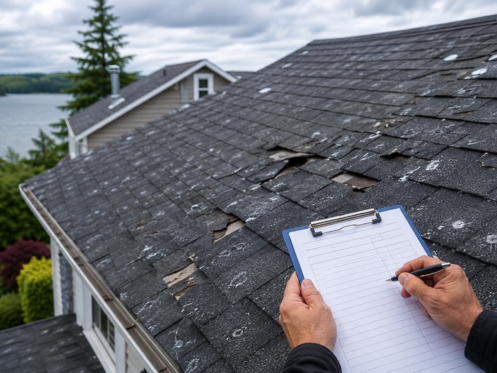
A July afternoon thunderstorm rolled across Lake Charlevoix and dumped quarter-sized hail on your neighborhood. Your roof looks fine from the driveway. Your neighbor’s truck has dimples. Two months later you find a slow drip in the upstairs ceiling — and that’s when you learn most insurance carriers expect you to file the claim within a year, document the damage with date-stamped photos, and prove the storm caused it. The choices you make in the first 72 hours after a Charlevoix hail or wind event decide whether you get $9,000 toward a new roof or a denial letter.
Key Takeaways
- Most Michigan homeowner policies require notice of a roof claim within one year of the storm — but the sooner you file, the better the outcome.
- Document everything before cleanup: date-stamped photos, video, the NOAA storm report, and a written contractor inspection.
- Hail and wind account for nearly half of all U.S. homeowner insurance claims by frequency — Charlevoix sits in an active corridor.
Why Charlevoix Sits in an Insurance-Active Storm Zone
Charlevoix and the surrounding Northern Michigan corridor sit downwind of Lake Michigan and Lake Charlevoix. That geography produces summer convective storms, hail bands, and microburst wind events. According to the Insurance Information Institute hail statistics, U.S. insurers paid out billions of dollars in hail-damage claims last year, with the Great Lakes region among the most active outside Hail Alley.
The NOAA Storm Prediction Center records for Charlevoix County show multiple wind and hail events every summer. Most are under-reported because cottage and second-home owners are not on-site to file. That gap is exactly what catches Charlevoix homeowners off-guard months later.
Hours 0-72: What to Do Immediately After a Charlevoix Hail or Wind Event
Step 1: Make sure the home is safe
Before climbing or inspecting, look for downed power lines and obvious structural damage. Stay out of the attic if you smell gas. If a tree is on the roof, call your utility and the city before anything else.
Step 2: Document everything before you touch a thing
Walk the perimeter and photograph every elevation. Use your phone — date stamps matter. Capture hail on the ground, dimples on car hoods, downed branches, and any ground-level damage to the home. This proves the event occurred and roughly when.
Step 3: Tarp openings to prevent further damage
If hail or wind broke a window, lifted shingles, or punctured the roof, cover with plastic sheeting or tarp. Most policies actually require this ‘mitigation’ step. Save receipts — typically reimbursable under your claim.
Step 4: Pull the NOAA report
Search the NOAA Storm Events Database for your zip code and date. Print or save the official report. This becomes proof of the storm event for your insurance file.
Hours 72+: The Insurance Claim Process Step by Step
Step 5: Get a written contractor inspection BEFORE calling insurance
Search Storm Damage Roofing Near Me and book a Charlevoix-area roofer for a free written inspection. The contractor’s report tells you whether real damage exists and ballparks the repair cost. Without this, you might file a claim for $300 of cosmetic damage that hits your policy record without paying back anything.
Step 6: Call your insurance carrier
Get the claim number, the adjuster’s name, and the inspection window in writing. Ask whether your policy covers emergency mitigation services and what the deductible is. Many Michigan policies have separate wind/hail deductibles — sometimes a percentage of dwelling coverage rather than a flat dollar.
Step 7: Meet the adjuster with your contractor present
This is the single best move you can make. Adjusters work fast and miss things. Your contractor knows what to point out — soft hail strikes that bruise without breaking, lifted shingles that look fine but are no longer sealed, granule loss patterns. Two trained eyes catch what one misses.
Step 8: Review the adjuster scope and decide on ACV vs RCV
ACV (Actual Cash Value) policies pay depreciated value — older roofs receive less. RCV (Replacement Cost Value) policies pay full replacement minus deductible, but typically require the work be completed before final payment. Confirm which yours is when you file.
Common Reasons Charlevoix Roof Claims Get Denied
Pre-existing damage or deferred maintenance
Carriers won’t pay for damage that existed before the storm. If your shingles were already curled and worn, they may classify the loss as ‘wear and tear’ rather than storm-caused.
Late filing
Most Michigan policies cap the claim window at one year. Some are shorter. The longer you wait, the harder it is to prove the storm caused the damage.
Cosmetic-only damage exclusions
Some policies exclude cosmetic hail damage to metal roofs. Read your declarations page or call your agent before assuming coverage.
Storm-chaser red flags
After major events, out-of-state contractors flood Northern Michigan. Many file inflated claims, take cash up front, and disappear. The Michigan Department of Insurance and Financial Services (DIFS) warns homeowners to verify Michigan licensing before signing anything.
Frequently Asked Questions
How long do I have to file a roof insurance claim in Michigan?
Most policies require notice within one year of the loss. Report the damage as soon as you discover it — claims filed within 30-60 days have higher approval rates.
Will my premium go up if I file a hail damage claim in Charlevoix?
Often yes for non-catastrophic claims, but weather-related events typically have less impact than at-fault claims. A single storm claim usually doesn’t move the needle as much as multiple maintenance claims.
What does the adjuster actually look for?
Hail bruising and cracking on shingles, wind-lifted shingles that have broken seal, granule loss patterns, flashing damage, and the difference between storm damage and pre-existing wear.
Should I get a roofer to inspect before calling insurance?
Yes. A free written inspection from a licensed Michigan roofer tells you whether you have a real claim before you put one on your policy record. GAF’s homeowner claim guide recommends contractor presence at the adjuster meeting.
What is the difference between ACV and RCV coverage?
ACV pays depreciated value at time of loss. RCV pays full replacement cost minus deductible. RCV requires repair completion. Older roofs benefit dramatically from RCV.
After the Storm — Here’s What to Do
The 72-hour window after a Charlevoix hail or wind event sets up everything that follows. Document fast. Tarp openings. Pull the NOAA report. Get a written contractor inspection BEFORE you call your carrier. Have the contractor at the adjuster meeting. Skip the storm-chaser knocking on your door three days later.
If a storm just hit your Charlevoix home, call F S Roofing & Construction LLC. We provide free written storm damage inspections across Charlevoix County and the wider Northern Michigan service area. Our GAF, CertainTeed, and Atlas certifications mean the report holds up with any adjuster.