Your upstairs bedrooms in your Northern Michigan home feel like a sauna by July. Your AC runs nonstop. Your shingle roof is only nine years old but already showing curl. Your attic insulation looks oddly compressed. You may be looking at the same problem from four different angles — bad attic ventilation. In Northern Michigan and across the wider Grand Traverse Bay area, roof ventilation is the most overlooked system in residential building. Get it right and your shingles last 25 to 30 years. Get it wrong and you’re paying to replace a roof that should still have a decade left.
Key Takeaways
- Proper attic ventilation requires a balanced 50/50 split between intake (soffit) and exhaust (ridge) — most Michigan homes have it wrong.
- Bad ventilation voids most major shingle warranties (GAF, CertainTeed, Owens Corning, Atlas) and can shorten roof life by 10 to 15 years.
- The Grand Traverse Bay humidity cycle plus Northern Michigan winter temps make attic moisture issues unusually common here.
Why Attic Ventilation Matters in Cherry Bend
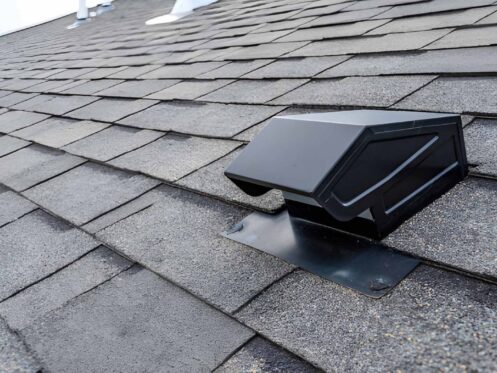
Attic ventilation does two jobs. In summer, it pulls hot air out of the attic so it doesn’t bake the underside of your shingles or radiate down through the ceiling. In winter, it keeps the attic cold enough that snow on the roof doesn’t melt unevenly and refreeze at the eaves. The U.S. Department of Energy attic ventilation guide calls balanced ventilation one of the highest-ROI fixes a homeowner can make.
Cherry Bend sits along the Grand Traverse Bay shoreline. That gives the area a unique humidity cycle — humid summer days, sudden cool lake-driven evenings, and freeze-thaw winter cycles. All three put extra moisture into attic air that needs to escape. Without balanced ventilation, that moisture condenses on rafters, soaks insulation, and feeds mold.
How Much Ventilation Does Your Cherry Bend Home Need?
The International Residential Code R806 sets the standard: 1 square foot of net free vent area for every 300 square feet of attic floor — assuming balanced 50/50 intake and exhaust. For a 1,500 square foot Cherry Bend ranch, that’s about 5 square feet of total vent area, with half at the soffit and half at the ridge.
Without a vapor retarder, the rule tightens to 1:150. Most Northern Michigan homes built before 1990 lack proper vapor barriers, which means they need more ventilation than newer construction. A Roofing Contractor Near Me search and a quick attic look will tell you whether your home is hitting the number.
Five Common Roof Ventilation Mistakes in Northern Michigan
1. Ridge vent installed without enough soffit intake
This is the most common mistake. The ridge vent looks great but has no air coming up to push out. Without balanced intake at the soffit, the ridge vent actually pulls conditioned air from the home through any attic-floor leak — wasting your heating dollars in winter.
2. Mixing ridge vents with gable vents
When both ridge and gable vents exist, they short-circuit each other. The ridge vent draws from the gable instead of the soffit, leaving the attic floor with stagnant air pockets. Either close the gable vents or remove the ridge vent — never run both.
3. Powered attic fans pulling conditioned air
Powered attic fans sound like a fix but often make things worse. They pull air from wherever they can — including through the attic floor, drawing your air-conditioned indoor air up and out. Most building scientists today recommend passive ridge-and-soffit systems instead.
4. Soffit vents blocked by insulation
When you (or a previous owner) added attic insulation, did installers use baffles to keep the soffit vent area open? In half the Northern Michigan homes inspected, insulation has been pushed down over the soffit, blocking intake. Easy fix, big impact.
5. Bath and dryer vents terminating in the attic
Bathroom exhaust fans and dryer vents that dump into the attic instead of through the roof or wall introduce massive moisture. This is a Cherry Bend kitchen-and-bath remodel red flag. Always run these vents to the exterior.
How Bad Ventilation Voids Your Shingle Warranty
Every major shingle manufacturer including GAF and CertainTeed requires code-compliant attic ventilation as a condition of the warranty. If a warranty claim arrives and the manufacturer’s inspector finds inadequate ventilation, the claim gets denied. Owners then pay full price for a replacement that should have been covered.
F S Roofing & Construction LLC carries Master Elite, CertainTeed, and Atlas certifications. Part of every full roof inspection includes a ventilation calculation and a written confirmation that your system meets warranty requirements.
Signs Your Northern Michigan Attic Has Ventilation Problems
- Upstairs rooms much hotter than downstairs in summer
- Energy bills 20-40% higher than neighbors with similar homes
- Ice dams forming at the eaves every winter
- Attic frost on rafters during cold snaps
- Mold or mildew smell in attic
- Premature shingle curling, especially on south-facing slopes
- Compacted, damp, or stained attic insulation
Any two of these together strongly suggest a ventilation issue. A professional attic and roof inspection is the cheapest first step. From there, the fix is usually adding soffit intake, installing baffles, or correcting a vent mix.
Frequently Asked Questions
How much attic ventilation do I need in my Northern Michigan home?
Code requires 1 square foot of net free vent area per 300 square feet of attic floor, balanced 50/50 between intake at the soffit and exhaust at the ridge. Without a vapor barrier, tighten the ratio to 1:150.
Should ridge vent and gable vent be combined?
No. Combining them short-circuits airflow. The ridge vent will pull from the gable rather than the soffit, leaving the attic floor with stagnant air. Choose ridge plus soffit, or close the gables.
Does a powered attic fan help in Northern Michigan?
Generally not. Powered fans often pull conditioned air from the home through attic-floor bypass leaks. Passive ridge-and-soffit ventilation is preferred by most building scientists today.
Will bad ventilation void my shingle warranty?
Yes. GAF, CertainTeed, Owens Corning, and Atlas all require code-compliant ventilation for warranty coverage. A warranty claim denied for ventilation reasons is one of the most common reasons homeowners pay out of pocket for a roof that should be covered.
How much does it cost to fix attic ventilation in a Northern Michigan home?
Adding ridge vent during a roof replacement is typically a $300-$700 add. Retrofitting soffit intake on an existing roof runs $500-$2,000 depending on access. Full ventilation correction during a re-roof is the cheapest moment to address it.
Get the Airflow Right Before Summer Costs You a Roof
Roof ventilation is the most overlooked system in your Northern Michigan home. Get the math right, get the balance right, and your shingles last decades. Get it wrong and you’ll replace a roof prematurely while paying higher cooling bills along the way. Inspect first, fix the simple stuff (baffles, blocked soffits, terminated bath vents) and only then talk about new vent installation.
Wondering if your Northern Michigan home has the ventilation it needs? Call F S Roofing & Construction LLC for a full attic and roof inspection. Our team handles Cherry Bend roofing service, shingle replacement, and ventilation correction across Grand Traverse Bay and Northern Michigan.